
In the sprawling, creature-filled archipelago of Palworld, Stones might appear unremarkable at first glance—small, gray polygons dotting the landscape like forgotten crumbs from a prehistoric feast. Yet these humble fragments form the skeletal lattice of progress, a silent currency that transforms a fragile camp into an industrial fortress. Every axe swing, every pickaxe strike, every sturdy workbench traces its lineage back to a pile of unassuming Stones. As of 2026, the game has evolved, but this truth remains carved in bedrock. Players soon discover that gathering Stones manually is akin to trying to fill a reservoir with a teaspoon—possible, but painfully slow when the hunger for construction grows.
The Relentless Hunger for Stones
From the moment a player steps onto the island, Stones act as the metronome of advancement. The first five Stones join five pieces of Wood to birth the Stone Pickaxe, a tool that replaces the bare-handed scrabble with a satisfying clinking rhythm. Later, they become the backbone of walls, furnaces, and crafting stations. As technology unlocks, the demand multiplies. Reinforced buildings swallow hundreds of Stones, and high-tier schematics treat them as commonplace ballast. The early game’s gentle trickle of pocketed pebbles turns into a roaring appetite that manual labor alone cannot satisfy. A player spending hours chipping at random boulders with a refined Metal Pickaxe is like a master carpenter forced to fell a forest with a pocketknife—the skill is there, but the scale is all wrong.
Manual Mining: The First Steps
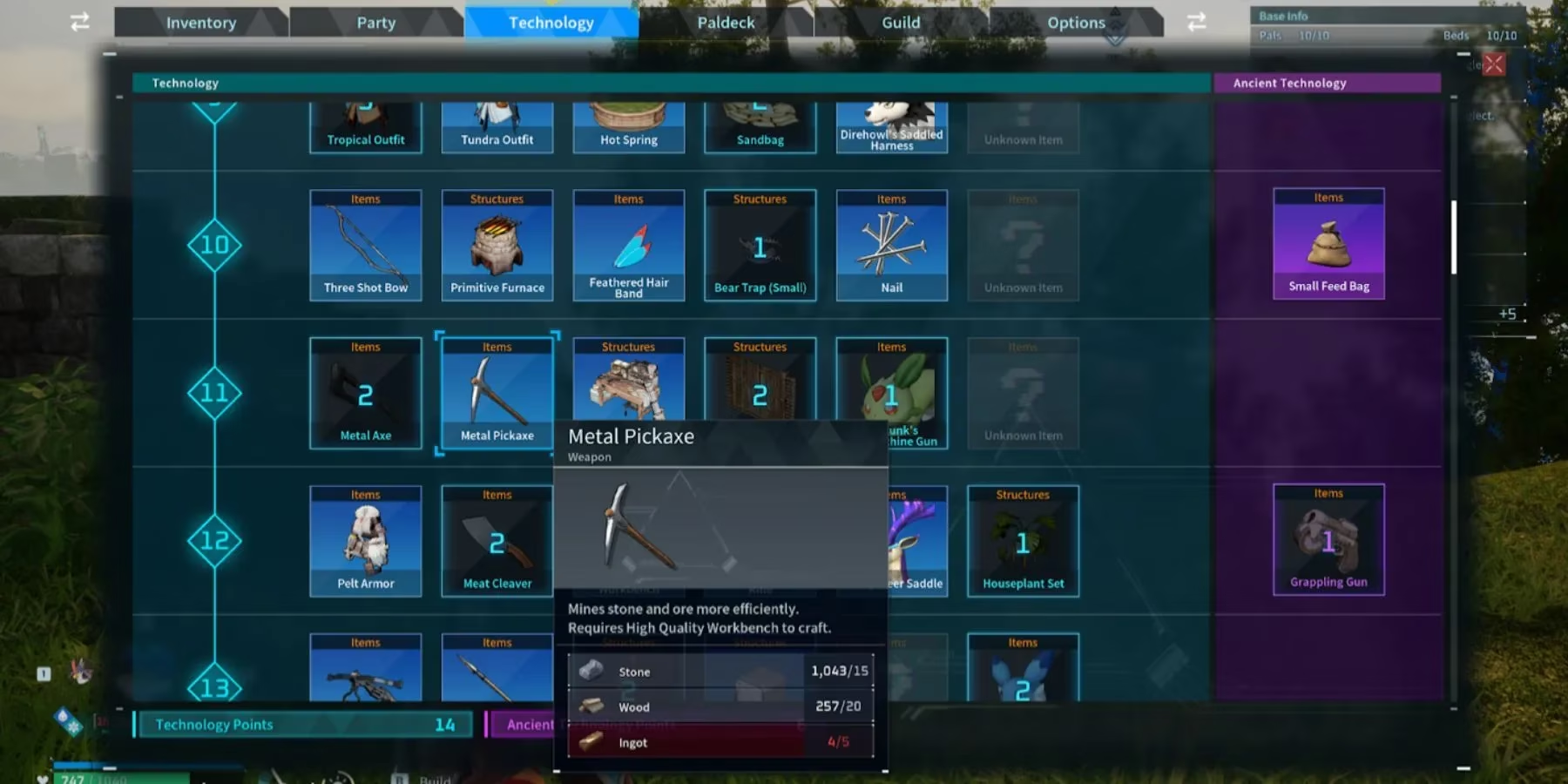
In the opening hours, manual collection is unavoidable and even meditative. Small stone deposits litter the starting zones, and a few swings with the basic Stone Pickaxe yield enough material for essentials. As soon as Ingots become available, forging a Metal Pickaxe upgrades the gathering speed noticeably. However, the return on time investment sharply declines once the base expands beyond a modest shack. The Technology tree dangles a far more elegant solution at level 7, one that shifts the paradigm from hunter-gatherer to industrialist.
Unlocking the Stone Pit: Automation’s Dawn
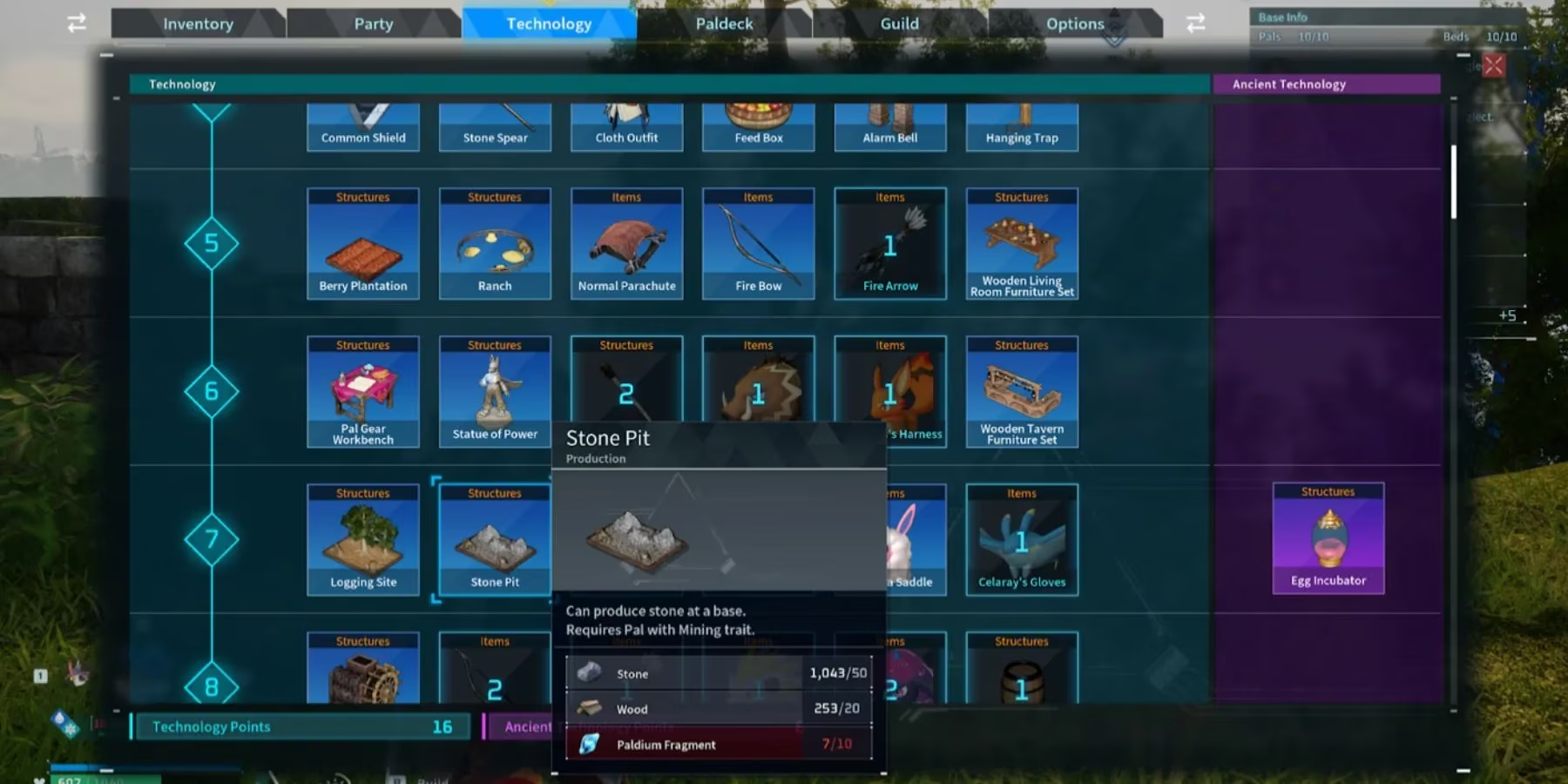
At level 7, the Stone Pit blueprint emerges as a quiet revolution. For a cost of 50 Wood, 20 Stone, and 10 Paldium Fragments, players can erect a structure that looks like a squared-off quarry waiting to be excavated. This is no mere decoration—it functions as a permanent, inexhaustible source of Stone right inside the base perimeter. The Stone Pit is the game’s way of acknowledging that a builder’s ambition should not be chained to the nearest rock outcropping.
The Engine of Production: Choosing the Right Pals
Automating the Stone Pit requires more than just building it—it needs living labor. Pals equipped with the Mining trait will autonomously hack away at the pit, turning it into a fountain of Stones. The game’s ecological hierarchy dictates that not all Pals mine equally. The cream of the crop includes Blazamut, a magma-veined titan whose rocky shell seems built for shattering, Astegon, a shadow-winged dragon with obsidian claws that rend stone like parchment, and Digtoise, a giant armadillo whose spinning shell becomes a natural drill. These top-tier miners possess high Mining levels, transforming a single Stone Pit into a conveyor belt of resources.
However, such powerhouses are typically locked behind high-level zones and challenging encounters. For players still finding their footing, Tombat and Depresso serve as loyal substitutes. Tombat’s bat-like agility hides a surprisingly methodical excavation style, while Depresso, with its tired eyes and surprisingly robust arms, chips away with a persistence that belies its lethargic demeanor. A base crewed by a handful of these mid-tier miners already ensures a steady stream of Stones while the player ventures out to capture the legendary diggers.
Storage and Logistics: Closing the Loop
Even the most industrious Pals will stall if there is no place to deposit their haul. Placing a few wooden chests adjacent to the Stone Pit creates a seamless workflow. Next, assign Pals with Transporting abilities—such as Cattiva or Killamari—to act as couriers, scooping up the accumulated Stones and ferrying them into storage. This setup transforms the base into a living organism: the Stone Pit is the heart pumping raw material, the transporting Pals are the bloodstream, and the chests become the lungs where goods settle before being inhaled by the crafting stations. Once this circulatory system hums to life, Stone shortages become a distant memory, allowing the player to focus on exploration, boss battles, or simply designing an aesthetically pleasing stronghold.
Beyond the Pit: Smart Stone Management
While the Stone Pit eliminates scarcity, a wise provisioner still understands the rhythm of consumption. Stone-based recipes dominate the early and mid-game, but they also feed into more complex production chains—Crushed Stone for pal feed, Stone Walls for fortifications, and conversions into Paldium Fragments in a pinch. Keeping at least two Pits running ensures that even during a massive building spree, there is no downtime. Moreover, the game’s 2026 updates have subtly reinforced this resource’s importance, making it a cornerstone in several newly introduced defensive blueprints. A neglected Stone supply can halt progress as abruptly as a snapped keystone in an arch.
The Alchemy of a Simple Resource
There is a peculiar alchemy in how Palworld elevates the mundane. Stones are not rare, they are not exotic, yet they sit at the nexus of survival and dominion. They mirror the player’s journey—first as a primitive tool in hand, then as an automated empire’s foundation. Like the mineral-rich soil that nourishes an ancient forest, Stones give rise to towering workshops and impregnable walls. Mastering their acquisition is less about hoarding and more about recognizing that the quietest systems often yield the loudest triumphs. In the end, every soaring Pal habitat, every advanced weapon, whispers a silent gratitude to the simple Stones that made it possible. And thanks to the Stone Pit and its diligent Pal operators, that gratitude never has to come from weary pickaxe arms but from a commander overlooking a well-oiled lithic kingdom.
Comments