
Palworld, the monster-collecting and base-building survival game that took the gaming world by storm upon its 2024 release, presents players with a vibrant yet demanding open world. While the core loop of capturing Pals, constructing bases, and exploring is engaging, the experience can be fraught with unexpected frustrations. A significant source of this stress stems not from hostile creatures, but from a fundamental game mechanic governing the player's creations: structure deterioration. This feature, common in survival genres, dictates that any building constructed outside the boundaries of a player's officially designated base will slowly decay over time until it collapses. For players looking to expand their creative horizons and reduce management headaches, a simple adjustment hidden within the game's settings offers a transformative solution.
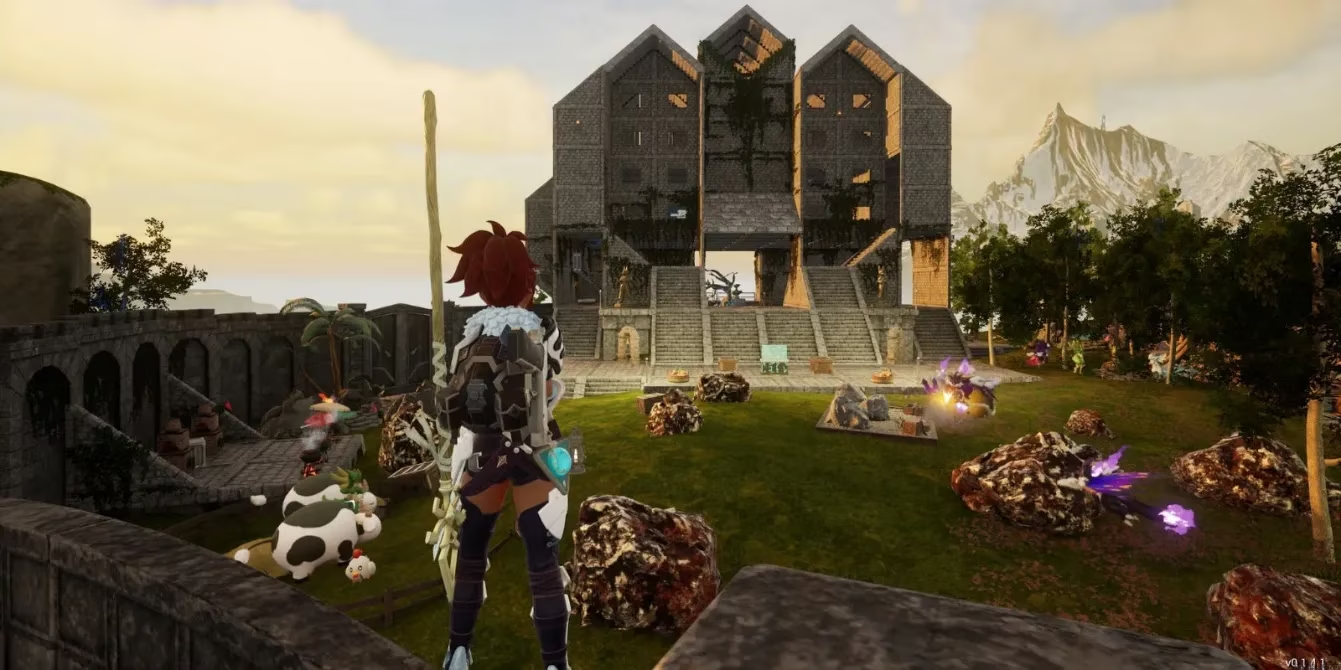
The Key Setting: Structure Deterioration Rate
Nestled within Palworld's difficulty options is a critical toggle: "Structure Deterioration Rate." By default, this setting is active, imposing a timer on any player-built structure—be it a storage chest near a rich ore vein, a staircase scaling a treacherous cliff, or a bridge spanning a chasm—that exists beyond the protective bubble of a Palbox-defined base. The consequence is a constant cycle of maintenance and potential loss, where thoughtfully placed outposts can vanish if not regularly repaired. However, by switching this option to "Off," players liberate themselves from this cycle. This single change removes the temporal decay from all external constructions, allowing them to stand indefinitely. The implications for gameplay and creativity are profound and immediate.
Unleashing Unbounded Creative Building
With deterioration disabled, the entire game world becomes a canvas. Players are no longer penalized for ambitious architectural projects or practical infrastructure built in the wilderness. This freedom fundamentally alters the approach to exploration and resource management. Key benefits include:
-
Permanent Outposts: Secure, reliable shelters and storage facilities can be established at key resource locations, dangerous dungeons, or simply at scenic vistas, functioning as permanent waypoints across the map.
-
Complex Infrastructure: Elaborate bridge networks, mountain pass staircases, and observation towers become viable long-term investments, permanently altering the landscape and improving traversal.
-
Experimentation Without Penalty: New players and veteran builders alike can experiment with structural designs and layouts outside their main base without fearing their work will crumble due to an oversight.
This setting effectively decouples creative expression from survival pressure, making the building aspect of Palworld feel more like a feature-rich creative mode within a survival framework.

Revolutionizing Base Defense and Expansion
The impact of turning off deterioration extends powerfully into base defense, a core concern in Palworld. Bases are strictly limited in size and number, especially in the early game, forcing players to make tough choices about how to use their precious allocated space. Defensive walls are desirable but consume area that could otherwise host resource farms, Pal beds, or crafting stations.
The most logical workaround—building defensive fortifications just outside the base's border—is rendered futile by the deterioration mechanic. A wall meant to stop raiding Pals will weaken and break over time, creating vulnerabilities. With deterioration off, this strategy becomes not only viable but highly effective. Players can construct expansive perimeter walls, moats, or gatehouse complexes at a distance from their Palbox, creating layered defenses without sacrificing an inch of internal base space. While this doesn't prevent Pals from spawning inside (which is determined by game code), it creates a robust buffer against the larger roaming world bosses and invasion events, allowing for a more strategic and relaxed approach to base security.
Why This Setting Detracts from Palworld's Core Experience
While survival game purists might argue that deterioration adds necessary tension and realism, its implementation in Palworld often conflicts with the game's unique strengths. The title's charm lies in its blend of creature collection, automation via Pals, and open-world building. The deterioration mechanic feels like an artifact from a more punishing survival genre, one that doesn't synergize well with Palworld's more playful, systems-driven core. It adds a layer of mundane maintenance that can detract from the joy of exploration and large-scale project completion. For the vast majority of players, from casual explorers to dedicated builders, disabling this feature removes an arbitrary obstacle, allowing them to engage more deeply with the parts of the game that are truly unique and compelling.
Practical Guide to a Better Gameplay Experience
Adjusting this setting is straightforward and can be done at any time, offering immediate relief. Here’s a quick summary of the before-and-after state:
| Aspect of Gameplay | With Deterioration ON | With Deterioration OFF |
|---|---|---|
| External Structures | Decay over time and require repair. | Remain permanently intact. |
| Creative Freedom | Limited by maintenance needs. | Nearly unlimited; build anywhere. |
| Base Defense Strategy | Walls must be built inside, wasting space. | Defensive perimeter can be built safely outside. |
| Resource Management | Includes constant repair material costs. | Resources focused on expansion and new projects. |
| Overall Experience | More stressful, punitive. | More relaxed, creative, and exploratory. |
In conclusion, the "Structure Deterioration Rate" setting acts as a hidden difficulty slider for the game's building and management aspects. Turning it off does not make combat easier or reduce the challenge of catching powerful Pals, but it does eliminate a pervasive source of frustration that hampers creativity. It aligns the game's systems more closely with a spirit of adventurous construction and permanent world-shaping. For players in 2026 who may be returning to Palworld after its numerous updates or experiencing it for the first time, making this simple change is one of the most effective ways to ensure their time in the Palpagos Islands is defined by creation and discovery, not by perpetual repair. The game, developed by Pocket Pair Inc., truly opens up when players are free to build their legacy without watching it slowly fade away.
Comments